Seattle Bubble has moved! Redirecting...

You should be automatically redirected. If not, visit http://seattlebubble.com/blog/and update your bookmarks.

Off-topic comment? Interesting link?
Head over to the forums, or click here for open threads.

Tuesday, November 14, 2006

Our Town A to Z

Alki - What you will become after your home becomes a boat anchor

Belltown - Experience fine dining while warding off homeless and addicts

Capitol Hill - Enjoy wearing your fauxhawk while calling 9-11

Denny-ile - Denial over the negative appreciation in your recent downtown Seattle condo purchase

Eastside - Close to Microsoft. Location, Location, Location

Fremont - Hippies have been displaced by hipsters

Goldilocks - Seattle RE is not too hot or cold - it's just right!

House poor - A condition many Seattleites may find themselves facing in 2007.

Irrational District - Someone needs to open a pizza joint up in this mug and fast

Jobs - Becoming increasingly scarce in any field related to real estate and other sectors tied to consumer spending starting in 2007

Klondike Gold Rush Museum - History of yet another asset bubble

Lake Washington - It's great if you have the $2M entrance fee

Mudslides - Increasing property values since 1901

Neighborhoods - If you can afford them, Seattle has some nice ones

Occidental Park - see Belltown

Pike Place Market - Much ballyhooed place for bruised fish and pan handling

Queen Anne - In need of a 40% haircut

Renting - A wise alternative to buying in this market. Have a little patience and buy beautiful Queen Anne view homes for pennies on the dollar by 2009.

Sailboat - A great place to live after your house capsizes

Tooth & Nail - How you'll be fighting to make the payments on your 1960's boxy Ballard money pit

Unemployment - What goes up when consumer spending goes down as a result of the housing bust

Vulcan - A company that consistently makes wise investment decisions

Weather - A major draw for the "equity locusts" of California

XXX - A city so liberal it proposes ridiculous laws (4 foot rule)

Y - Why not buy a house today?

Zoning - New zoning laws will finally allow all those Vancouver-like condos to be built downtown, thus cementing our bubble-proof status .

A parody of this post.

God Save the Queen

A Seattle developer says he plans to save two historic apartment buildings by converting the units to condos.

"The trouble with many of these old buildings is it just doesn't pay to keep them up when you've got them as apartments," Ben Rankin, a principal of developer Pioneer Property Group, said while touring the Pittsburgh apartment building last week.

"We can offer things that are priced substantially below the new construction here and have the architectural advantage," Rankin said. "I feel that if there is a real need, it is for inexpensive owned housing in the city."
I'd venture there's a need for inexpensive rentals as well. People don't -need- to own, they want to - but certainly not by 2007 when we'll be deep in the throws of the national housing retrenchment.
On its Web site, Pioneer Property Group says it makes money on niche developments, but also has a "social mission" to "increase the density and supply of urban housing without adverse impact on our architectural heritage or the urban landscape."

"You could build a condo tower on a site that may have a five-story walk-up apartment building now," he said.

Developers are converting the Pittsburgh, a lower Queen Anne apartment building, into condos. But converting an apartment building to condos instead generally brings needed investment in an old building and creates many owners, complicating any subsequent move for demolition, Chaney said. "We think that's not a bad model."
It's not a bad model, it's an insane one. Building a new condo from scratch would take several years, where a condo conversion can be done in a matter of months. Condo conversions usually signal the end of a housing boom cycle as they're seen as a "fast buck" before the Scheiße hits the ventilator.

No matter how you sugar coat it, renters will need to find a new place to live. Worse yet, I predict these units will "repartment" themselves less than one year after they're finished. I have nothing against capitalism and during a "normal" market I can see how this would work. Unfortunately this developer is just going to waste everyone's time.
The condos range from 430 to 750 square feet, costing $239,000 to $370,000. The Pittsburgh will have four small condos selling for about $150,000. That's inexpensive by Seattle standards, but not within the reach of most of the building's renters.

Rankin said he did not see how he could make the condos that affordable in the city. The developers provided all residents with the $500 the state requires in relocation just for low-income tenants and have someone searching out nearby apartment vacancies, he said.

"There still are a lot of buildings out there for rent," Rankin said.

But Michelle Thomas, a community organizer for the Tenants Union of Washington State, said Seattle is losing too many affordable apartments.

"I'm not sure that preserving a building at the cost of preserving apartments that are affordable is that much of a priority," she said.
Sounds wonderful, doesn't it? A kind benefactor swoops down to save a few buildings from ruin, while at the same time providing a much needed service. I will enjoy watching them try to sell these!

(Aubrey Cohen, Seattle P-I, 11.14.2006)

Friday, November 10, 2006

Reader Question: TV News Interview Advice

Here's a question from Doug, a reader our almost-neighboring state of Montana:

Hi Tim (and friends). I've been really enjoying this blog lately. I'm a RE market watcher in Montana, so it's good to see news and real analysis from the Northwest.

I made a little video about my market and, amazingly, a local TV station found it and e-mailed me. They want to do an interview and show parts of the video on their evening news later this month.

Just wondering if you or your readers have any advice on how to come across. The reporter already said she was interested in knowing my motivations for making the video.

Presumably, I'm going to be viewed as a sort of doom-and-gloomer who wants to ruin the party, put developers out of business, and flush our economy (largely based on construction) down the toilet. I think we have some real problems, and I want to point them out without coming across as a jealous renter.

Any ideas, besides wearing kevlar after it airs? Thanks.

(For the record, I am a renter. But honestly, the more I rent the more I enjoy it. Even if I thought it was wise to buy today, I'm not sure I'd give up the flexibility of renting).
Congratulations Doug on being recognized for your work. The video to which Doug is referring can be viewed here. I highly recommend you check it out if you haven't seen it already. Doug lays out the basic facts of his local housing market in a simple, easy-to-follow, and compelling way.

My advice is to be as friendly and positive as possible. It's hard for people to dislike someone who is smiling and comes across as wanting the best for everyone. Also, as you're talking, be aware that most of what you say will be destined for the editing room floor. News programs air soundbites, so you want to be careful about getting into any kind of lengthy explanations of your position, because they almost certainly will take something that you say completely out of context. If something takes more than two sentences to explain, either drop it or think of a shorter way to say it.

So what about all you readers? What advice would you give to Doug? Be constructive please. Insults or off-topic rants will be deleted from this thread.

The Joys Of Condo Ownership

Once in a while, I used to get the crazy idea that it would be fun to own a condo. I was probably attracted to the relatively low price tag (compared to SFHs). However, whenever I looked into it, I was always turned off by the ridiculously expensive Home Owner's Association fees, usually ranging from $250 to as much as $500 per month. "What could be that expensive," I thought... Well, here's a good example of why condo associations frequently have to stockpile so much money: leaky condos and MIA builders.

The owners of 20 Ballard condominiums have fallen victim to the Legislature's good intentions.

The Ballard Square Condominium Owners Association sued the building's developer, Dynasty Construction Co., in 2002, claiming that their recently built homes were riddled with leaks that had caused extensive building damage and asserting that Dynasty failed to meet construction standards.

The problem was, Dynasty was dissolved in 1995, and superior and appeals courts said the owners could not sue a corporation after its demise. But the owners appealed to the state Supreme Court, which heard the case earlier this year.
...
Ballard Square had missed its opportunity. The Supreme Court unanimously dismissed the case.
...
Lara Stack moved into Ballard Square 4 1/2 years ago, several years after leaks were discovered and repaired, and a month before owners found more extensive problems.

"Water was seeping inside the stucco of the building through many different entry points," said Stack, who is the vice president of the association.

Deck structures and wood framing also were starting to rot, she said.
...
In 2000, state Sen. Jeanne Kohl-Welles, D-Seattle, proposed requiring certain guarantees from homebuilders, including five-year protection from defects resulting in water penetration. The bill never got a vote.
...
"I had just been thinking about reintroducing this bill again," she said.

But this is all too late for the residents of Ballard Square, who are spending $1.8 million to fix their building (not to mention legal fees), and are living through renovations that are now halfway done.

"We don't have privacy. There's dust everywhere," Stack said. "We just want to move on and have it complete."
The article discusses the builder tactic of forming an LLC, building the condos, then dissolving the LLC. Apparently this tactic has increased in the past "as the boom hit and [the builders] built so many of the darned things." Under a new state law, condo owners can still sue the LLC for up to three years, but after that you're pretty much out of luck.

Food for thought if you're looking at condos as a way to save you from being priced out forever.

(Aubrey Cohen, Seattle P-I, 11.10.2006)

Wednesday, November 08, 2006

"The Market is Returning to Normal"

Now that the NWMLS numbers have been released, let's check in with our favorite bubble-fighting dynamic duo, Rhodes & Cohen. If you were expecting them to cheer on the inexplicable increase in prices, you will not be disappointed. This month's unified message: Prices are up, but now is the time to buy! From Ms. Rhodes' article; Home sales drop, not prices.

Prospective homebuyers who've been frustrated by too much competition for too few homes — your time is now.

But don't expect to find widespread price breaks, because home prices are up.

In fact, after four months of either steady or slightly declining prices, King County's median single-family house price rose in October to $440,000, up from $425,000 in September.

The number of houses and condominiums for sale in the central Puget Sound region — King, Snohomish, Pierce and Kitsap counties — was up from 27 to 59 percent last month, compared with a year earlier, according to statistics released Tuesday by the Northwest Multiple Listing Service.

Increasing inventory is giving buyers more clout, said Lennox Scott, chairman and chief executive of John L. Scott Real Estate.

"We're adjusting from a frenzied market back down to a strong market," Scott said. "Buyers have selection."
It's pretty much the kind of booster material we've come to expect out of the Times: a strong focus on price gains and little to no mention of statistics that point to a slowdown.

On the other hand, although Ms. Cohen's article has a similar focus, it comes out a lot more balanced. I don't know if it was intended this way, but the sarcastic tone of the headline pretty much says it all: It's a buyer's market, if buyer's loaded.
More and more home sellers are chasing fewer and fewer buyers, but those who did buy in October paid more than buyers did the month or year before that, according to housing statistics released Tuesday.

The Northwest Multiple Listing Service's October report continued a trend of increasing numbers of homes on the market and fewer sales month over month and year over year. The median home price in the city was $420,000, the same as July's price after two consecutive months of declines and represented the largest year-to-year increase since July.

King County as a whole showed a similar trend, with a slightly smaller increase in inventory, a decline in sales from October 2005 and a slightly higher rise in the median home price.

The price statistics reflect what home shoppers such as Dariush Zand are seeing.

"They keep saying it's a buyers market," he said while looking over a Montlake home last month. "Prices haven't changed. I don't see any reduction."

Zand, who is planning to move back to the area from San Jose, Calif., said prices have declined there.

"California's starting to look like a pretty good deal now," he said. "And it's sunny and 75 (degrees) every day."
Of course, she still managed to throw in a heaping helping of real estate booster talking points, including the recent favorite, "the market is returning to normal."
The statistics show the market is returning to normal, said Glenn Crellin, director of the Washington Center for Real Estate Research at Washington State University.

"Yes, the inventory is going up," he said. "It's still sitting lower than it was three years ago."

Buyers now can take time to search out the house they really want, rather than jumping at something that will do, Crellin said.

"Because of the period of frenzied activity, we sort of lost sight of what a normal market looks like and feels like."
Is it possible that while the housing market collapses in the rest of the country, Seattle just "returns to normal"? Sure, anything is possible I suppose. However, with the inventory still increasing YOY at a faster rate every month, and sales still on the decline, I have to wonder what mysterious force is going to stop these trends once the market has become "normal"?

(Elizabeth Rhodes, Seattle Times, 11.08.2006)
(Aubrey Cohen, Seattle P-I, 11.08.2006)

Monday, November 06, 2006

Inventory Eases (Very) Slightly In October

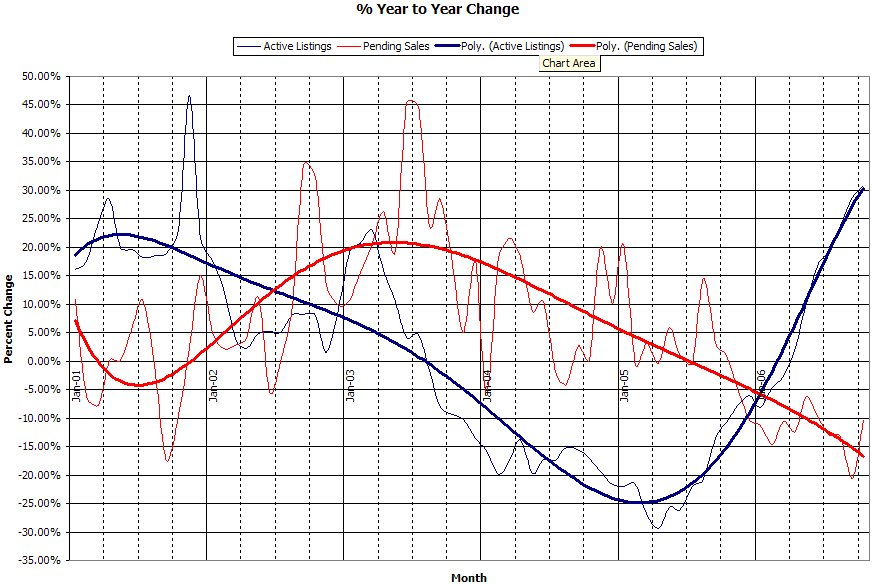
The NWMLS has posted October statistics. Although residential (excludes condo) inventory did indeed follow its usual October downward course, the decrease of less than 1% of listings was the smallest since at least 2000 (I don't have reliable inventory statistics further back). The YOY increase in inventory stands at almost 31%—a new record—while the YOY decrease in pending sales eased to 10% (from 20% last month).

The statistic that I find most bizarre is the median price of closed residential sales, which increased $15k (3.5%) from last month. The median price has only increased by more than 3% from September to October one other time since 1993—in 1995.

Anyone out there care to venture a guess as to what the heck is going on? Have home buyers in King County all gone 100% mad? What could possibly have driven prices up another $15,000 in one month?

P.S. - The Seattle Bubble Spreadsheet has been updated.

Skagit's Housing Market Staying... Strong?

Slowdown denial is in full force up in Skagit County, where in an article titled "Skagit's Housing Market: Staying Strong," a monthly rag called Skagit County Business Pulse has apparently resorted to publishing outright lies.

People will go to great lengths these days to own property, especially packages with added value. Despite the high cost of housing — a 38.3 percent increase in Skagit County alone in the past year — buying activity is up and inventory down.
Bzzt—three lies in one sentence. According to the most recent NWMLS figures, Skagit County home prices were up just 5.27%, sales were down 27%, and listings were up 51% in September vs. a year earlier. August figures are similar.
Skagit home sales have been driven by three principal demand sources, according to Jim Scott, president of the North Puget Sound Association of Realtors and owner of Windermere Real Estate/James Scott Associates in Mount Vernon.

"One is the continued growth of our county’s work force, another is the desirability of our county as a place to live and raise kids, and the third is pressure from tight housing supplies south and north of us," he states. "We value our climate and our culture so much we’re willing to pay a premium to protect and enjoy it."
Inventory in Snohomish County (south of Skagit): up 28% YOY. Inventory in Whatcom County (north of Skagit): up 72% YOY.
According to the latest figures from the 17-county Northwest Multiple Listing Service (NWMLS) in Kirkland, the average price of a home in Skagit County in August was $318,454. That was a drop of 8 percent from July when the mean was $344,440, but considerably above that for the previous August, when it was a mere $230,250.
You might be wondering: "why are they referring to average prices instead of median, and why are they using August numbers, when September statistics have been out for a month?" Well I don't know why they would choose to print average prices, but it is rather convenient that the average they quote is considerably higher than the August median of $270,000. As far as the August vs. September question, the median dropped about $5,500 from August to September, which doesn't really fit well with the title "Staying Strong" subtitle.
Where in many locations around the country the housing boom shows signs of slowing — the so-called “bubble” bursting, as some pundits would have it — sales activity in Skagit County has increased appreciably over one year, from 645 units in August 2005 to 972 in the same month this year, even though pending sales dropped from 259 to 209 in the same period and new listings decreased from 307 to 300.
While they did manage to sneak a little bit of truth into this paragraph (pending sales drop & new listings) the author apparently needs to take a course on how to read the NWMLS report. What the writer refers to as "sales activity" is actually total number of active listings—inventory.

Our real estate reporting here in Seattle usually leaves a lot to be desired, but at least the local papers don't waste our time with completely false data like this. Of course, if they do, rest assured that I'll be here to call them out.

(Skagit County Business Pulse, 11.2006)

Friday, November 03, 2006

Got Bankruptcy?

Realtors buy big ad campaign

‘It’s a great time to buy or sell a home,’ says $40 million marketing push

It might go down as the “Got milk?” moment for the housing sector.

Just as dairy associations, with their widespread ads, have tried to convince Americans of the many benefits of milk, the National Association of Realtors will begin promoting the notion that buying a home is an unalloyed good. Their $40 million campaign boldly declares: “It’s a great time to buy or sell a home.”

The ads will try to counter the drumbeat of dour housing data and news by making the case that historically low interest rates, a large supply of homes on the market and the group’s forecast of rising prices next year make now an ideal time to buy a home.

The campaign, developed by the Most Agency, based in Newport Beach, Calif., starts today with full-page ads in The Wall Street Journal and USA Today. It will make its way into other newspapers, including The New York Times, over the weekend and onto television and radio networks early next year.

“In visiting our local associations and state associations, we were hearing our members saying, ‘We are getting beat up out there,’” said Thomas Stevens, president of the trade group that represents 1.3 million real estate agents and owner of a real estate brokerage firm in the Washington, D.C., area.

“We think we need to tell them that the stars are aligned right now, and the conditions are ideal for buyers,” he added.

Independent economists, however, are somewhat more skeptical. Many predict that sales and prices, as measured by the association, which fell in August and September from a year ago, might decline further because there are too many homes on the market and because the rapid run-up in prices has put home ownership beyond the financial reach of many people.

“You can make the case that prices will rise in areas of the country that did not have a bubble,” said Ethan Harris, chief U.S. economist at Lehman Brothers. But “in the hot markets, I would say you are in for a two- to three-year adjustment in prices, not a collapse but a steady drop in prices.”

So far, prices have not dropped in the Puget Sound area. In September, the median price in Pierce County was up 1.35 percent from a year ago.

Harris recommends that buyers base their purchase decisions on whether they intend to live in an area for a few years, not on the outlook for home prices.
(Vikas Bajaj, The New York Times, 11.03.2006)

A Question Of Affordability

It is generally accepted that the more desirable an area is, the less affordable it is to live there, and specifically, to buy a home. For instance, homes in San Francisco have always been ridiculously expensive—even considering the higher median income there—because it's considered by many to be a highly desirable place to live.

For reference, here are the affordability indices (definition) for a few cities (using county-wide data from City-Data.com) around the country as of the year 2000.

CityAfford.
Houston, TX204
St. Louis, MO181
Sioux Falls, SD176
Phoenix, AZ147
Miami, FL121
Seattle, WA94
Boston, MA88
San Diego, CA87
San Francisco, CA58
New York, NY20
I think most people would agree that in general, cities that are lower on this list are more desirable. Obviously everyone has different opinions and preferences about what they like in a city. When I say that City A is "more desirable" than City B, I am not making any personal value judgment, but rather all I am saying is that some statistically significant percentage of people would prefer to live in City A if given the choice.

Allow me to lay out the point of this post in a very logical way.

Premise: More desirable = less affordable (and vice versa)
Fact: King County's affordability index dropped 26.7 points 2000—2005.
Fact: The affordability indices of many less-desirable locations were either stagnant or increased from 2000 to 2005.1
Query: How has King County become 29% more desirable since 2000?

This is a completely serious question. If affordability was dropping nation-wide, then I could buy the argument that massive home price gains are due to "fundamentals." However, that is simply not the case. Huge increases in home prices have been largely limited to cities on the coasts.

If someone would care to make an argument explaining how our area is 29% more desirable now than it was in 2000, I'm all ears. Otherwise, I'm inclined to believe that the 29% affordability drop has more to do with speculation than with "fundamentals."

1For instance, the affordability index for St. Louis, MO dropped just 4 points from 2000 to 2005 (source), while the index for Houston, TX actually increased 20 points (source).

Thursday, November 02, 2006