Seattle Bubble has moved! Redirecting...

You should be automatically redirected. If not, visit http://seattlebubble.com/blog/and update your bookmarks.

Off-topic comment? Interesting link?
Head over to the forums, or click here for open threads.

Thursday, November 03, 2005

2,000 Acre "Mini-Cities" Debated In Snohomish

Snohomish County is considering a proposal to allow supposedly "self-contained" communities. The Everett Herald reports on a public hearing last night:

The mini-cities - built as large housing and commercial developments - are called fully contained communities, and continue to suffer criticism for not being fully contained.

Such developments would require at least 2,000 acres of rural land in an area at least a mile from other urban areas under proposed county rules.

Half the land must be protected as a natural buffer, and one job must be provided for each house, condo or apartment.

"The biggest problem they always have is employment," said Grady Helseth, a developer from Snohomish.

Without jobs that pay enough to cover their mortgages, thousands of residents would be forced to commute to job centers in established cities.
And thousands of non-residents will commute to the "contained community" from cheaper neighborhoods to work the low-wage jobs. This is beginning to sound pretty much the same as a normal (uncontained?) community.
"There is no need for a new city in the rural area," said Kristin Kelly, spokeswoman for the anti-sprawl group Futurewise and the Pilchuck Audubon Society.

Kelly said officials are dreaming if they think people will live and work only within the development's confines.
I would have to agree. Also, what is to stop "investors" from purchasing homes in these fantasy communities and further driving the prices up above what the pre-planned jobs can support?

(Jeff Switzer, Everett Herald, 11.03.2005)

Wednesday, November 02, 2005

Bigger = Better?

When it comes to houses, it seems most people have the American sentiment of "bigger = better = I want" ingrained into their subconscious. The Seattle P-I takes a look at how this mentality is shaping the Seattle residential landscape:

During the past 10 years, about 2,400 single-family homes have been razed to make way for apartments, condos and larger homes. With strong demand for in-city housing and few vacant lots, older homes are now disappearing three times faster than they did a decade ago -- with 368 demolished last year.

Some neighborhood activists -- who support increasing density and building affordable housing in urban villages -- see little public benefit in replacing modest homes with expensive single-family behemoths.
...
Builders say the trend is fueled by simple economics and a healthy demand for larger homes inside Seattle. As traffic gets worse, some people want to return to the city, but not to a two-bedroom bungalow with tiny closets and bad wiring.

"If there wasn't a market for these houses, nobody would be building them," said Greg McGar, a contractor who paid $492,000 for a Ballard home last year, according to property records. He knocked it down and is building two four-bedroom homes on the oversized lot.
Of course there's a market right now, but will there be in 5 years? How likely are these homes to retain their value when a leveling off in real estate comes? I've always thought that one of the sacrifices of living in or near a big city was having a smaller home. I guess some people have enough money to have it both ways though. Either that or they have a "great" zero-down interest-only loan so they can "afford" it. I'd be curious to see if this trend continues when today's easier-than-breathing financing dries up.
Some neighbors are happy to see eyesores torn down and replaced with nicer homes that boost property values, said Jim Morse, a contractor who recently tore down a small rental on 28th Avenue Northwest and is building a three-story home there.

Others hate change, he said.

"You can give people hundred-dollar bills all day long, and some people aren't going to like it," he said.

"In reality, we're improving the neighborhood by getting rid of old, dilapidated housing."
Congratulations Jim Morse, you win the prize for stupidest analogy of the week!

(Jennifer Langston, Seattle P-I, 10.24.2005)

Tuesday, November 01, 2005

Don't Wait To Buy?

Writer Tom Kelly offers an opinion piece in the Everett Herald in which he takes a very matter-of-fact tone. To hear him tell it, there's no question, prices will not decrease in the Puget Sound:

Is there significant merit in waiting for the local housing market to cool before jumping in to buy a home? While that question may be on the minds of many consumers, the reality of a significant drop in home prices and a rise in inventory is rather remote.
...
The idea of "saving my money until home prices come down" has probably become a contradiction in terms - at least for the foreseeable future. Yes, housing is cyclical but it usually does not go backward for very long, if at all. The additional money you save now probably will not offset the appreciation (albeit slower than today's torrid pace) you would have accrued had you found a way to purchase a local home sooner rather than later.
If it were as certain as Mr. Kelly makes it sound, why would I even have created this blog? Either I'm a total idiot, or Mr. Kelly is making things sound a bit more definite than they are. Perhaps he's a realtor. *wink*

(Tom Kelly, Everett Herald, 10.23.2005)

Monday, October 31, 2005

Seattle Residents Fleeing To Ellensburg?

Okay, so that title was a bit overdramatic. But that's the job of a "reporter" right? Heh. Anyway, about 100 miles east of Seattle on I-90, the Ellensburg area is experiencing its own real estate boom, with new homes popping up at a record pace:

Building permits issued for new homes in Kittitas County outside city limits hit an all-time high of 286 in 2004, an increase over the 235 issued in 2003.

The 2004 record level was reached and exceeded on or about Oct. 19, according to Darryl Piercy, director of Kittitas County Community Development Services.

"It's definitely a continuation of the trend we've seen in the last few years," Piercy said. "This area is tremendously attractive if you live in the Puget Sound area where your faced with traffic congestion, a large population and crime."
I'm not familiar enough with real estate lingo to know whether 286 permits means 286 homes, or 286 projects (which could each be multi-home), so I'm not sure how big a number we're really talking about here, but it's apparently enough to get noticed frequently by the locals. Speaking of locals, it seems that quite a few of the new homes aren't going to be inhabited by them:
Piercy estimated 20 to 25 percent of new homes are second or vacation homes.

Bob Hansen, a 31-year veteran in real estate, said if the nation's economy doesn't change dramatically, the boom trend could continue through 2006, at least.
...
He said a Seattle resident looking to retire in the Kittitas Valley can sell their $300,000 to $400,000 home and come here, buy acreage in the country and build a new home. The demand is high for three- to five-acre rural lots.

"They want to get out of the mess over there," Hansen said. "It's the lifestyle they are after."
Or is it the relatively cheap land that they think will appreciate considerably in the coming years? When I hear "second or vacation home" lately, that tends to be translated in my head as "investment home." Good thing a "dramatic" change in the nation's economy is so unlikely. Right?

(Mike Johnston, Ellensburg Daily Record, 10.22.2005)

Follow-Up: Anecdotal Evidence

Way back in early September I made a post with the details of two properties in my neighborhood that had recently been put on the market.

The house in question has still not sold, and has now been languishing on the market for over 10 weeks. The price has been dropped from $350,000 to $319,950 (an 8.5% drop), but there have apparently still not been any takers. In my opinion they're still asking way too much in a painfully obvious attempt to take advantage of the peak, but I'm no expert (which should go without saying). I will keep you posted.

The condo I was watching closed on October 6th, for a total of $280,950—$6,000 (2%) over the asking price. The total length of time from listing to closing for the condo was approximately one month. Apparently this inspired the owner of the neighboring unit because within the past seven days the condo next door (parcel # 8035550060) has gone up for sale, with an asking price of $300,000. I'll keep an eye on this one as well.

Wednesday, October 19, 2005

Thurston County Continues Upward

Nothing shocking going on here, just more confirmation of local neighborhoods still on the rise. Specifically, this story is about Thurston County.

South Sound's booming housing market and recovering economy are contributing to record gains in Thurston County property values.

For the second year in a row, Thurston County set a record for gains in residential property tax assessments.

This year's overall 12 percent gain beat last year's 8 percent gain, which was a record dating back to at least 1999, according to Dennis Pulsipher, the county's chief deputy assessor. Such gains are reflected in 108,000 assessment notices scheduled to be mailed Wednesday to property tax payers.
Those lucky tax payers!

(Jim Szymanski, The Olympian, 10.18.2005)

Tuesday, October 18, 2005

Kitsap County Continues To Soar

You may recall last month that over on the other side of the Sound Kitsap County made King County's gains look small, and in the month of September they've done it again, with Silverdale posting a 36.7% year-on-year increase.

Doney said the demand for affordable housing continues to increase, but that demand has the perhaps unintended affect of driving prices up, pushing south the line between affordable neighborhoods and higher priced ones.

A year ago in September, of the 19 Kitsap County areas measured by the listing service, Silverdale was the ninth most expensive. This September it came in sixth.

In Central Kitsap 108 homes sold during September, up 21 from the same month a year ago. More than half of those were in East Central Kitsap, where the median price jumped from $189,000 to $249,975, a 32.3 percent increase.
Affordability has left the building.
View/Hide the entire article
CK Home Prices Jump

October 16, 2005

While the usual suspects -- Bainbridge Island and North Kitsap -- continue to see housing price increase, Silverdale appears to gaining momentum.

"I think it comes down to affordable housing," said Cathy Doney, a broker in the Silverdale Reid Real Estate office.

The median home price in Silverdale was $312,250 in September, compared to $228,495 in the same month a year ago, according to figures released by the Northwest Multiple Listing Service.

The 36.7 percent median Silverdale home price increase matches the rise on Bainbridge Island, where the median home price jumped from $416,250 to $569,000.

Doney said the demand for affordable housing continues to increase, but that demand has the perhaps unintended affect of driving prices up, pushing south the line between affordable neighborhoods and higher priced ones.

A year ago in September, of the 19 Kitsap County areas measured by the listing service, Silverdale was the ninth most expensive. This September it came in sixth.

In Central Kitsap 108 homes sold during September, up 21 from the same month a year ago. More than half of those were in East Central Kitsap, where the median price jumped from $189,000 to $249,975, a 32.3 percent increase.

Apparently, the view of Seattle had an impact last month as well. Prices in the Manchester/Retsil area of South Kitsap jumped 48.5 percent, from $191,950 to $285,000.

The median price in East Bremerton went up 16.3 percent to $223,750, while West Bremerton at $157,500 saw a 6.2 percent jump.

Doney said the demand for affordable housing will eventually create higher home value increases in Bremerton, too.

In terms of total volume, buyers spent a total of about $164 million on 493 homes during September, and average of $333,114, a 10.3 percent rise in sales and a 22.2 percent increase in average price.

Kitsap County's 18.6 percent overall median home price increase $221,000 to $262,000 was 11th highest in the areas the Northwest Multiple Listing Service covers. Mason County median prices increased 20.9 percent from $145,000 to $175,250.

The median home price was $349,898 in King County, $245,000 in Pierce County and $285,000 in Jefferson County.

By Steven Gardner

sgardner@kitsapsun.com
Hide the entire article
(Steven Gardner, Kitsap Sun (free sign-up req.), 10.16.2005)

Monday, October 17, 2005

Sunday Comics Bubble Humor

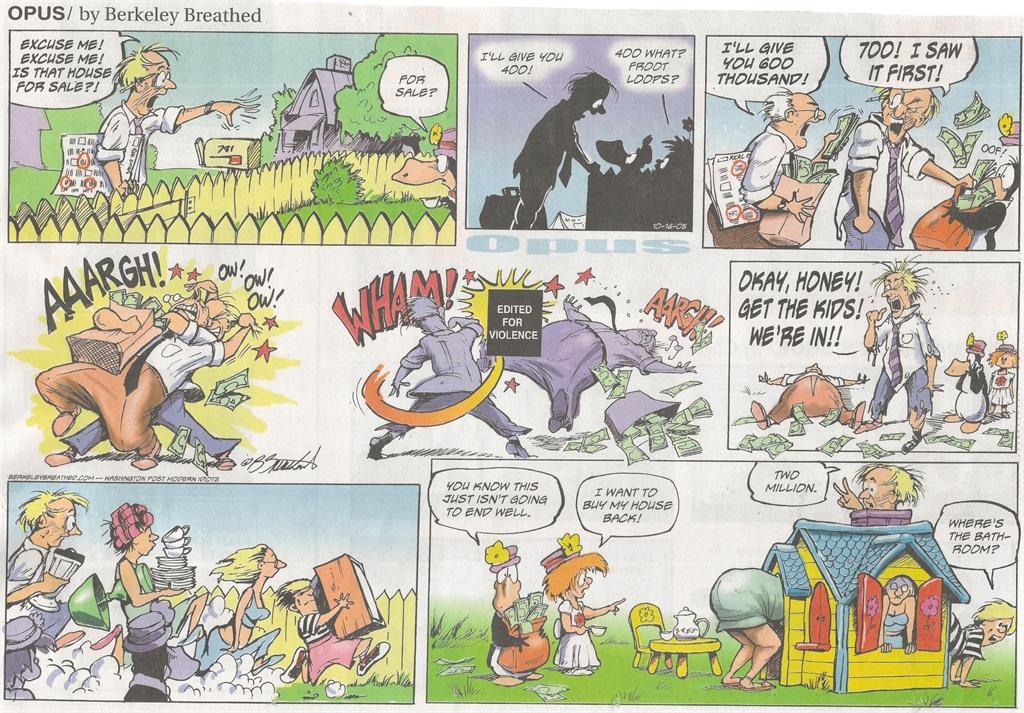
I failed to mention this before, but I'm actually on vacation right now, through October 30th. So expect posts here to be sporadic, but I will try to get in an update every few days. Although it doesn't have anything to do with Seattle specifically, I thought some of you might enjoy this comic I saw in the Sunday paper. Click it to view a larger version.
Opus - 10.16.2005
(Berkeley Breathed, Washington Post, 10.16.2005)

Friday, October 14, 2005

Schools Want A Piece Of RE Tax Revenues

Here's another update on the continuing focus on the "spend or save" question when it comes to property & real estate tax revenue windfalls. The Seattle Education Association chimes in on the side of "spend," requesting a big piece of the pie.

The Seattle Education Association (SEA), which represents the district's teachers, instructional aides and office staff, called on the City Council and Mayor Greg Nickels to set aside for the district $25 million a year for the next five years. The city expects to collect about $55 million more than analysts had predicted in sales, business and real-estate taxes by the end of next year.
While the city is not immediately acquiescing to the request, it seems the debate isn't whether to spend or save, but rather just how to spend.
Nickels' spokeswoman, Marianne Bichsel, said the city has sustained $120 million in budget cuts over the past three years, and that the higher-than-expected revenue should be used to restore funding to public safety, transportation and human services.
Great idea. Then we can go through the exact same budget cuts a few years from now when the real estate money tree shrivels up and dies.

(Sanjay Bhatt, Seattle Times, 10.13.2005)

Tuesday, October 11, 2005

Yet Another Real Estate Search Site

Fun! New! More ways to research how best to throw huge piles of money you don't really have into the local real estate market!

Finding the home of your dreams can take months of research. But thanks to new online tools -- including aerial maps that incorporate residential listings -- potential home buyers now have a wealth of information at their fingertips.

Today, Kirkland-based HouseValues Inc. will throw some of its muscle behind online aerial maps with a free service called HomePages that allows consumers in 120 cities to peruse house listings, previously sold homes, nearby parks and other information with a bird's-eye view. It joins a host of other online real estate mapping services -- including HousingMaps.com, Redfin and Trulia -- that are hoping to change the way people find local real estate information.
I'm beginning to think that Tom of Seattle Property News may have been onto something when he said "Is there a regional bubble in online real estate sites?"

(John Cook, Seattle P-I, 10.11.2005)