Seattle Bubble has moved! Redirecting...

You should be automatically redirected. If not, visit http://seattlebubble.com/blog/and update your bookmarks.

Off-topic comment? Interesting link?
Head over to the forums, or click here for open threads.

Tuesday, May 08, 2007

April Reporting Roundup

Here's a compilation of what your local press (aka real estate advertisers) had to say about last month's home sales data from the NWMLS. It's depressing to think that these sources are where most people get their news of the market from...

Elizabeth Rhodes, Seattle Times:
King County home prices keep rising, bucking national trend
Buying a home here: You'll pay even more

"Overall, people have been getting worn out paying what in their opinion is an inflated price," Martin said.

Plus there are significantly more properties to choose from compared with a year ago.
Mrs. Rhodes' article is riddled with inaccurate assertions such as a claim that decreasing sales are "explained" by increasing inventory (huh?), and a quote that sales activity is "improving" and "at a faster pace than last year." She also says "Whether April will be the strongest month remains to be seen," when in fact it is already known that March experienced both more sales and larger price increases than April. Take home lesson: When reality isn't as rosey as you'd prefer, just pretend that it is!

Aubrey Cohen, Seattle P-I:
Home sales in city shoot up 14% in April
Anshul and Christine Pandhi were in their second week of seeing what they could get for $500,000 to $700,000 if they moved from Tacoma to Seattle.

"It's expensive," Anshul Pandhi said. "In our price range, the pickings are pretty slim."

John and Sahrah Marcantonio sold their Woodinville house in November and have been renting in Seattle while looking for a house in the city.
...
Sahrah Marcantonio was pessimistic about the market, but didn't care.

"I think it's a bubble, we're at the peak of the bubble, and yet, I want a house now," she said. "It's for the long term."
Aubrey's article was much more even-handed than we've come to expect. I was floored by the quotes he managed to get out of recent home buyers.

Devona Wells, Tacoma News Tribune:
Housing market still shows signs of slowing
The jump in the number of Pierce County houses and condos for sale puts the county at a six-month supply, generally considered the point a market moves from one favoring sellers to one favoring buyers, said Dick Beeson, a Windermere real estate broker and MLS director.

"The news is, pay attention, sellers, you’re not going to have the spring and summer you usually have," he said.
Apparently the market just south of us is a bit harder to spin in a positive light. Of course, that doesn't mean they aren't trying...
...though sales have slowed, [John L. Scott agent David Gala] said Tacoma homes under $400,000 remain hot. Two of his listings priced at $250,000 and $210,000 sold in the last week after multiple offers, Gala said.

But agents say three to six months tends to be the time it takes to sell a home today. As recently as two years ago, homes often sold in a few days.
Mike Benbow, Everett Herald:
Buyers drive up condo sales
While Snohomish County houses are less expensive than in King County, they're still out of reach for many people in the market, especially with the tightening of loan qualifications that has followed the recent increase in home foreclosures.

That has attracted more people to condos and their much lower price range.
Those buyers had better get into any type of home they can possibly afford, because as everyone knows, if they don't buy now, they'll be (you guessed it) priced out FOREVER!

Rolf Boone, The Olympian:
Condos sustain housing market
The pace of new South Sound loan applications has so far been strong this year, said Jeff Devlin, a Wells Fargo Home Mortgage consultant. Devlin said he doesn't sense the "doom and gloom" today that hung over the real estate market a year ago.
Hmm. Year over year pending (res + condo) sales down 15%, listings up 50%. SFH median up 9% vs 23% (April '05-'06). But the market is in better shape today than a year ago. Yeah.

Just for kicks, here are a couple of stories from a little further out in Western Washington than we usually focus on.

Dave Gallagher, Bellingham Herald:
Home sales slowing as supply rises

Evan Caldwell, Longview Daily News:
Region's home sales bucking U.S. trend

(Elizabeth Rhodes, Seattle Times, 05.08.2007)
(Aubrey Cohen, Seattle P-I, 05.08.2007)
(Devona Wells, Tacoma News Tribune, 05.08.2007)
(Mike Benbow, Everett Herald, 05.08.2007)
(Rolf Boone, The Olympian, 05.08.2007)

Monday, May 07, 2007

Listings Way Up, Sales Continue Descent

It's time for April statistics from the NWMLS. King County SFH summary:

April 2007
Active Listings: up 38% YOY
Pending Sales: down 10% YOY
Median Closed Price: $465,000, up 11% YOY

Sales continued their descent, making April the 17th of the last 18 months to register a YOY decrease in pending sales. Likewise, inventory continues to balloon, registering the highest YOY increase to date.

Despite the downward pressure of increasing supply coupled with decreasing demand, median prices still rose $10,000, for a 10.85% YOY increase. Apparently the increasingly small number of people that are still buying are all too happy to continue paying higher prices. Perhaps they're frightened of being priced out forever.

Months of supply bumped back up to 3.00.

As is the custom, I have uploaded an updated copy of the Seattle Bubble Spreadsheet that contains the relevant data. Here is the recap NWMLS pdf.

Here's the supply/demand YOY graph:

Here's the chart of supply and demand raw numbers:Here's the graph of YOY percent change in the median sale prices of single-family homes in King County since 1994:I predict that the $10,000 increase in median prices will be the primary focus of our friends at the Times and P-I.

Tick, tock, tick, tock...

My Clients Don't Have Any Money

Living most of my life in Florida, cockroaches were a fact of life. In general, if you spotted one cockroach, that meant there were at least 1,000 others somewhere, waiting in the wings.

In the past few months homeowner subprime sob stories have been coming at us from all over the country, ad nauseam. With Washington state in the top five for toxic loans, you'd figure we'd see more local stories.

Here's one from the Seattle Times this morning: Borrower, beware: Debt disaster looms as rates rise on easy-money mortgages

It was a sweet little house, with affordable day care nearby for their 6-year-old son. Patrick Fultz and Laurel Swartz were hooked.

But when the couple — with no savings and about $20,000 in credit-card debt — shopped for a mortgage to buy their 1,200-square-foot house in Tukwila last year, they heard the same thing from lenders and in a home-buying class they attended: Forget it.

"You basically had to be Scot free, no massive credit debt, which we had, and to have money in the bank, which we didn't," said Swartz, 31. "How do people buy houses in America anymore?"

Fultz thought he had found just what he was looking for when he came across Gold Mortgage Lending in Renton on the Internet. "No income verification mortgage, zero down," read the firm's Web site. "We fund mortgages the others can't."

Erin Rearden, a mortgage counselor at Solid Ground, a nonprofit social-service agency in Seattle, said the deal Fultz and Swartz struck is typical, especially as the cost of housing skyrockets out of reach for so many.

"They wanted a home. And a lot of this comes from operating under the assumption that owning a home is an inherent American right. So when someone offers a way to do it, you want to go for it," she said.

Fultz makes $12.75 a hour driving a fish-food delivery truck. He recently paid off half of the 12 credit cards he used in buying a motorcycle, a couch and a television, going out to eat, "just buying stuff," Swartz was working at an insurance office, where she made $11.75 an hour.

The couple signed two mortgages to buy their $246,800 house in July. The first loan, a so-called pick-a-payment loan for 80 percent of the deal, had a variable interest rate. The second mortgage, at 12.5 percent interest, covered the rest.

Not long after they signed the loan, Swartz decided to dump her sedentary office job to become a personal fitness trainer. The new job paid less, $7.89 an hour, but she had the opportunity to earn commissions as she brought in clients.

The commissions, however, didn't materialize. At the same time, the interest rate on the first mortgage went up, from 7.06 to 8.15 percent — and it can go up every month until topping out at 11.5 percent.

Suddenly the couple were $300 a month short of paying their bills.

"I feel sorry for anyone who can't get into a house," Mills said. "We beg the banks to give us their turn downs. I help people; that's the bottom line."
Editors note: Always watch your back when a commissioned salesperson beings a sentence with "I help"

But today, people like Fultz and Swartz aren't the only ones having money problems. Mills, and brokers like her, have troubles of their own.

A meltdown in the subprime lending market is drying up the money pipeline.

Across the country, where home values are stalled or plummeting, lenders are watching loans turn upside down, with mortgages grown larger than property values. People behind in payments are losing their homes. Entire neighborhoods in parts of the Midwest and California are shuttered by bad debt.

The situation is nothing like that in Seattle, where increasing home values can still grease the mechanics of subprime deals.

But even here, lenders have stopped serving subprime clients or are imposing tighter requirements to qualify, from higher credit scores to a couple of months' worth of payments in the bank and at least some money down.

"For my clients, that is a deal killer," Mills said. "My clients don't have any money."
Wait a minute... I'm confused. I thought your customers were people that already didn't have any money? Or were you talking about the money to pay your broker fees?

The pullback has cratered the business model for brokers like Mills. She used to write 10 to 15 loans a month. In March, she wrote two. In February? None.

"I didn't make my own mortgage payment this month," Mills said in April. "But nobody feels sorry for me."
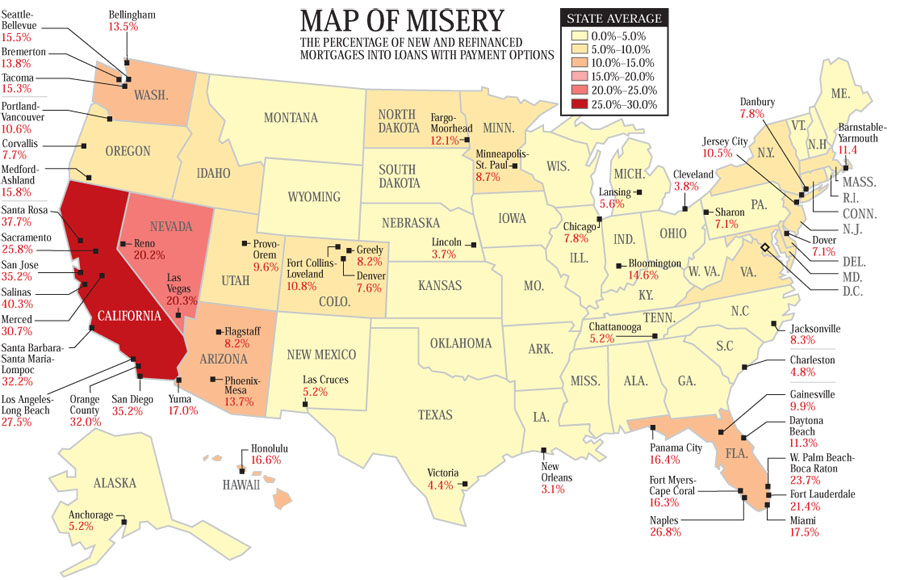
While the map of misery shows a percentage of toxic loans of roughly 15%, I wonder how many of these loans were written in just the last year or so?

Where will future "buyers" get the money for even a 5% down payment. If there are less buyers, what will that do for Seattle home values?

Now that we've seen one homedebtor facing foreclosure story here in Seattle, I wonder how many other stories are out there?

(Lynda V. Mapes, Seattle Times, 05-07-2007)

Friday, May 04, 2007

Throw More Money at the Problem

Problem: Housing in the Seattle area is too expensive.
Government solution: Artificially inflate the buyer pool by throwing millions in government loans at the problem.

Seattle will soon stake low-income housing developers in the cutthroat bidding wars for building sites.

The idea, which the City Council's Housing, Human Services and Health Committee approved as a two-year pilot project earlier this week, is to lend developers money fast and early — up to five years before they're ready to build.

The program will help non-profit developers secure sites before Seattle land costs get even more out of hand and better compete against their for-profit counterparts, who often can move more quickly, said Kollin Min, regional program director in Seattle for Enterprise Community Partners, an organization that helps fund low-income housing.
...
The program will get $2 million a year through 2009 from the city housing levy's operating and maintenance fund.

That's just a start, Min said.

"It's a very good first step," he said. "We need to have a larger pot to really make a dent in the problem."
...
The Legislature authorized a separate $1 million earlier this year for a similar program statewide.
...
Forty percent of the program money would go to home-ownership programs for residents earning 80 percent to 120 percent of the median income. Other money could go to rental housing for people making no more than 80 percent of the median income.
How does "spend more money" make sense as a solution for the problem of something being too expensive? I'm no economist, but I'm pretty sure that projects like these only serve to further drive up prices.

Should local and state governments bother trying to get involved at all, or should they just let the market work itself out?

(Aubrey Cohen, Seattle P-I, 05.03.2007)

Wednesday, May 02, 2007

To Open Thread or Not to Open Thread?

Thanks to the cessation of daily open thread posts during and after my recent vacation, participation in the forums has really taken off. However, when I announced on Monday that I would cease posting open threads for the foreseeable future, a number of you protested.

While I am certainly glad to see the forums well-utilized, I also don't want to alienate those of you who have contributed some of the most interesting discussion to this site. When I post daily open threads, forum usage declines, but without open threads, some people don't really participate as much. So I'm looking for some kind of middle ground.

Does anyone have suggestions for a way that we can facilitate open thread discussion without decreasing forum usage? I was thinking of reducing the open thread frequency, or placing it one click away from the front page (like the forums already are).

What do you think of either of those ideas, and what are some other things we might try?

Tuesday, May 01, 2007

Renting in Seattle "may make economic sense"

Finally some semi-useful information out of Dupre + Scott. Mr. Cohen reports on the "1-19 Unit Report" just released by Dupre + Scott in this terrifying tale of skyrocketing rents and plummeting vacancies:

Rental houses get scarce, expensive

The good news for people who cannot afford to buy a house in Seattle is that it may make economic sense to rent for the moment.

The bad news? Rental houses are a lot harder to find and pricier than they were a year ago.

The typical Seattle rental house now costs $1,604 a month, up 4.6 percent from a year ago, according to data that Dupre + Scott Apartment Advisors released Monday. House rents for all of King and Snohomish counties were up 6.5 percent from a year ago.

Dupre + Scott did not release vacancy rates just for houses, but among all King County rental buildings with one to 19 units, including houses, the rate declined from 3.7 percent a year ago to 3.1 percent now. The house trend is similar to that for apartments in general, according to Dupre + Scott.
It should be noted that even this report excludes homes or condos rented out by individuals. According to the Dupre + Scott website, the 1-19 Unit Report is derived from a survey of "apartment owners, professional property managers, and on-site property managers." Given the logistical complexity of such a task, you can't really blame them for not surveying individual owners, but it's important to keep in mind what this data is and is not telling us.
Dupre + Scott's April apartment report asserts that people would make more money renting, and investing the money they save elsewhere, than paying current prices to buy a home.

"There are a lot of reasons to own a home," Dupre + Scott co-owner Mike Scott said. "From a purely financial perspective I'd say no, it doesn't make sense. But if home prices go up 10 or 15 percent in the next year, I'll have to eat those words."
That makes about as much sense as the following: "There are a lot of reasons to visit a casino. From a purely financial perspective I'd say no, it doesn't make sense. But if you make 10 to 15 percent profit on your next visit, I'll have to eat those words."

No words will in fact need to be eaten, because even if home prices go up another 10 to 15 percent next year, it still doesn't make financial sense to buy a home right now. To put it another way... Just because a reckless decision paid off in the short term doesn't mean that it wasn't reckless, it just means that you were lucky.
Bob Melvey, assistant manager of Windermere Real Estate's Ballard office, said renting and investing the savings might pay off "if someone is very, very disciplined and they truly do put that difference in the stock market and they do a good job of managing their stock portfolio."

But most people would end up spending the savings on other things, Melvey said. "Owning your own home is, to a degree, a forced savings plan."
A "forced savings plan" where 80% of the money you "deposit" in the first five years simply vanishes (the interest portion of the payment), and from which you can only withdraw money by paying a 6-9% fee (not on the amount you have "saved" mind you, but on the total sale price) and relocating. Wait, that doesn't sound anything like a savings plan.

To give these figures a bit of perspective, let's say that the average single-family home at $1,583 (King/Sno) is comparable to the median home, which sold for $454,950 last month (King), resulting in an approximate PITI payment of $3,400. We will assume the homebuyer had 20% (almost $100,000) to put down, and we will ignore maintenance, HOA, utilities, and tax deductions in order to keep this simple. Right off the bat, the renter's monthly payment just 46.6% of the buyer.

It would take 13 years of 6.5% rent hikes before the renter's payment exceeded the homeowner's. Of course, during that time, the renter's $90,000 in liquid investments will likely have doubled or tripled, and that doesn't even consider that they're adding the monthly savings to the investment. If they bank the difference, their $90,000 could quite easily become $500-$600k. Also, if you think that rents will increase steadily at 6.5% per year for the next 13 years, I don't think you have a very good grasp of history.

Suffice it to say that despite the scary language in the headline of Mr. Cohen's latest volley, renting still beats buying in the Seattle area hands down (financially speaking).

(Aubrey Cohen, Seattle P-I, 04.30.2007)

Monday, April 30, 2007

Vacation Link Roundup

Looks like I didn't miss too much Seattle housing news while I was gone. I'm looking forward to seeing the April numbers next week. Here's a summary of what I noticed while clearing my inbox:

I'm also pleased to report that my nefarious scheme of going on vacation appears to have had the desired effect on the forums. Membership swelled by nearly 30%, and posting activity skyrocketed. Here are a few of the more popular and/or interesting threads:Therefore, I believe it is time to say goodbye to the open threads. For the foreseeable future, all user-driven discussion will take place on the forums. Thanks for your participation. I really enjoy reading what everyone comes up with.

Saturday, April 28, 2007

On Vacation, Check the Forums!

Click here to go to the forums.

I'll be on vacation with little to no Internet access through the 28th, so I likely won't be making new posts during that time. This includes open thread posts.

I strongly encourage everyone to head over to the forums while I'm gone. It only takes a few seconds to create an account, and the discussion is 100% user-driven.

Here are a few forum tips:

  • After logging in, you'll see an orange icon () next to any groups that have new posts since your last visit.
  • To post a link, use the following format: [url=http://yourlinkhere.com/]Here is my link[/url].
  • If you have problems, either PM Lake Hills Renter or Synthetik.
  • You can also try emailing me, but there's no guarantee I'll be able to get back to you.
Next time I'll try to line up a series of guest posters when I head out.

In the mean time, click here to go to the forums.

Tuesday, April 24, 2007

Developers! Developers! Developers!

Reporter Aubrey Cohen and the Seattle PI are at it again, this time pimping new development in Columbia City.

A Seattle developer has proposed a mixed-use project in Columbia City aimed at providing homes typical workers can afford to buy, while another developer also has condo plans in the up-and-coming South Seattle neighborhood.

The 63-condo development, called Columbia City Place, would be built on a vacant former auto lot at 5201 Rainier Ave. S., and units would cost between $200,000 and $400,000 -- plus whatever inflation tacks on in the two years before the project is completed, said Scott Shapiro, managing director of Eagle Rock Ventures LLC.

Shapiro said he and partner Murray Kahn are keeping prices down by using more basic finishes and wood construction for the upper floors, rather than concrete and steel, by installing above-ground parking and by building in Columbia City, where land is cheaper.

"It's a huge risk because no one's done condos of this scale in Columbia City," Shapiro said. "I could be in the right place at the right time or I could be three years early."
Or maybe three years too late?
"We've already explored heading north," he said. "We can't go east and we can't go west. Continued development going down the Rainier Valley is going to be a foregone conclusion."

While other developers are thinking about building in the area, Shapiro's project is "pioneering," Gardner said. "I think he's on the leading edge, definitely."
More like bleeding edge!

Columbia City is "a little neighborhood with a soul," said Denny Onslow, Harbor's chief development officer.

Projects such as these would have been "unthinkable" a decade ago, said Darryl Smith, who bought his Columbia City home in 1994 and became a Windermere Real Estate agent there the following year.

Smith said the projects would create new housing opportunities for people who cannot afford a house or those who might want a smaller home within walking distance of shopping and services. He also praised Harbor officials for saying they want to work with community members on their project and respect Columbia City's character.
Does anyone else call BS on this? If you need to sell something, simply cite affordability or the environment (or both!) and it's in the bag! Evidently Columbia City is the new Ballard.

Check out some of the comments on PI's blog:

"Face Reality" said "What this really means is that land and housing in Ballard, Fremont, Cap Hill, etc has become so expensive that even most developers can't afford to build because housing there is now beyond the reach of even the most affluent. ...Say goodbye to affordable housing in Rainier, hello to gentrification. As has already occurred in the “real” Columbia City."


"heebie_jeebies" added "I don't know why we have to accept these monster townhouse cookie-cutter firetraps...I live on Capitol Hill and have NOTHING good to say about allowing development and density that is absolutely killing our neighborhoods."


"financeguru" chimed in with "Wont development increase the property values of people that currently own near the new condo development? YES! I currently own a condo at the edge of Downtown and First Hill…and yes there are many areas that have high levels of drug usage and other things. Im getting my MBA at SU and it would be nice to see some of these abandoned buildings in the Capital Hill area cleaned up…"
(Aubrey Cohen, Seattle PI, 04-20-2007)

Thursday, April 19, 2007

WaMu Trying to Cope With Slowdown

Local mortgage giant Washington Mutual has been in the news quite a bit the last few days. On Tuesday, Seattle Times business reporter Amy Martinez made the (not-so-bold) prediction that WaMu won't escape subprime turmoil.

During the housing boom of the past several years, Washington Mutual was among the nation's top lenders in the high-risk sector of subprime mortgages.

Now subprime loans industrywide are failing at an alarming rate.

Although the Seattle-based thrift has cut back its subprime lending, it still has a lot of the loans on its books.

Exactly how vulnerable it remains will become clearer today when WaMu holds its annual shareholders meeting and releases first-quarter financial results.

The high-credit-risk market known as "subprime" represented 9 percent of WaMu's overall loan portfolio at the end of 2006. Analysts who follow the company predict first-quarter profit will suffer as a result.
Un-shockingly, she was proven absolutely correct later that day when WaMu's first quarter results were released:
Washington Mutual Inc. said Tuesday its first-quarter profits slid 20 percent amid a nationwide implosion of the subprime home loan market.
...
Kerry Killinger, Washington Mutual's chairman and chief executive, said the company's retail banking, card services and commercial groups fared well, while the home loan market - particularly the subprime segment for consumers with high-risk credit histories - remained a serious challenge.

Washington Mutual's home loans group posted a first-quarter loss of $113 million compared to a $52 million profit during the year-ago period. The company suffered a quarterly loss of $164 million on sales of subprime mortgages, alone.

To limit further damage as the housing slump continues, Washington Mutual said it had scaled back its subprime portfolio and had set aside more money to cover future loan losses: $234 million for the quarter compared to $82 million in first quarter 2006.

"Over the past 12 months, we have taken a number of prudent actions to reduce our exposure to the subprime mortgage industry," Killinger said in a statement. "These actions, along with a diversified business mix, limited our exposure to the mortgage market's downturn and position us well to expand and grow as market conditions improve."
Among those "prudent actions" is an open offer to refinance some of their riskiest loans into more traditional products at discounted rates:
Washington Mutual Inc. said Wednesday it will refinance up to $2 billion in subprime mortgages to help borrowers avoid default and foreclosure.

The program will allow subprime borrowers who remain current on their existing loans and are bracing for payment increases to apply for discounted fixed-rate loans or other refinancing options.

"Stepping up and helping our customers stay in their homes is in the best interest of our borrowers, our communities and WaMu," Kerry Killinger, chairman and chief executive of the Seattle-based savings and loan, said in a statement.
Will measures like these be enough to keep WaMu from experiencing serious financial pain as the consequences of yesterday's loose lending begin to pile up? Only time will tell, but at least WaMu has one important thing going for it: headquartered in the specialest place on earth!

(Amy Martinez, Seattle Times, 04.17.2007)
(Bill Virgin, Seattle P-I, 04.17.2007)
(Associated Press, KOMO TV, 04.17.2007)
(Associated Press, Seattle P-I, 04.18.2007)
(Bloomberg News, Seattle P-I, 04.18.2007)