Seattle Bubble has moved! Redirecting...

You should be automatically redirected. If not, visit http://seattlebubble.com/blog/and update your bookmarks.

Off-topic comment? Interesting link?
Head over to the forums, or click here for open threads.

Showing posts with label Seattle_is_special. Show all posts

Monday, May 07, 2007

My Clients Don't Have Any Money

Living most of my life in Florida, cockroaches were a fact of life. In general, if you spotted one cockroach, that meant there were at least 1,000 others somewhere, waiting in the wings.

In the past few months homeowner subprime sob stories have been coming at us from all over the country, ad nauseam. With Washington state in the top five for toxic loans, you'd figure we'd see more local stories.

Here's one from the Seattle Times this morning: Borrower, beware: Debt disaster looms as rates rise on easy-money mortgages

It was a sweet little house, with affordable day care nearby for their 6-year-old son. Patrick Fultz and Laurel Swartz were hooked.

But when the couple — with no savings and about $20,000 in credit-card debt — shopped for a mortgage to buy their 1,200-square-foot house in Tukwila last year, they heard the same thing from lenders and in a home-buying class they attended: Forget it.

"You basically had to be Scot free, no massive credit debt, which we had, and to have money in the bank, which we didn't," said Swartz, 31. "How do people buy houses in America anymore?"

Fultz thought he had found just what he was looking for when he came across Gold Mortgage Lending in Renton on the Internet. "No income verification mortgage, zero down," read the firm's Web site. "We fund mortgages the others can't."

Erin Rearden, a mortgage counselor at Solid Ground, a nonprofit social-service agency in Seattle, said the deal Fultz and Swartz struck is typical, especially as the cost of housing skyrockets out of reach for so many.

"They wanted a home. And a lot of this comes from operating under the assumption that owning a home is an inherent American right. So when someone offers a way to do it, you want to go for it," she said.

Fultz makes $12.75 a hour driving a fish-food delivery truck. He recently paid off half of the 12 credit cards he used in buying a motorcycle, a couch and a television, going out to eat, "just buying stuff," Swartz was working at an insurance office, where she made $11.75 an hour.

The couple signed two mortgages to buy their $246,800 house in July. The first loan, a so-called pick-a-payment loan for 80 percent of the deal, had a variable interest rate. The second mortgage, at 12.5 percent interest, covered the rest.

Not long after they signed the loan, Swartz decided to dump her sedentary office job to become a personal fitness trainer. The new job paid less, $7.89 an hour, but she had the opportunity to earn commissions as she brought in clients.

The commissions, however, didn't materialize. At the same time, the interest rate on the first mortgage went up, from 7.06 to 8.15 percent — and it can go up every month until topping out at 11.5 percent.

Suddenly the couple were $300 a month short of paying their bills.

"I feel sorry for anyone who can't get into a house," Mills said. "We beg the banks to give us their turn downs. I help people; that's the bottom line."
Editors note: Always watch your back when a commissioned salesperson beings a sentence with "I help"

But today, people like Fultz and Swartz aren't the only ones having money problems. Mills, and brokers like her, have troubles of their own.

A meltdown in the subprime lending market is drying up the money pipeline.

Across the country, where home values are stalled or plummeting, lenders are watching loans turn upside down, with mortgages grown larger than property values. People behind in payments are losing their homes. Entire neighborhoods in parts of the Midwest and California are shuttered by bad debt.

The situation is nothing like that in Seattle, where increasing home values can still grease the mechanics of subprime deals.

But even here, lenders have stopped serving subprime clients or are imposing tighter requirements to qualify, from higher credit scores to a couple of months' worth of payments in the bank and at least some money down.

"For my clients, that is a deal killer," Mills said. "My clients don't have any money."
Wait a minute... I'm confused. I thought your customers were people that already didn't have any money? Or were you talking about the money to pay your broker fees?

The pullback has cratered the business model for brokers like Mills. She used to write 10 to 15 loans a month. In March, she wrote two. In February? None.

"I didn't make my own mortgage payment this month," Mills said in April. "But nobody feels sorry for me."
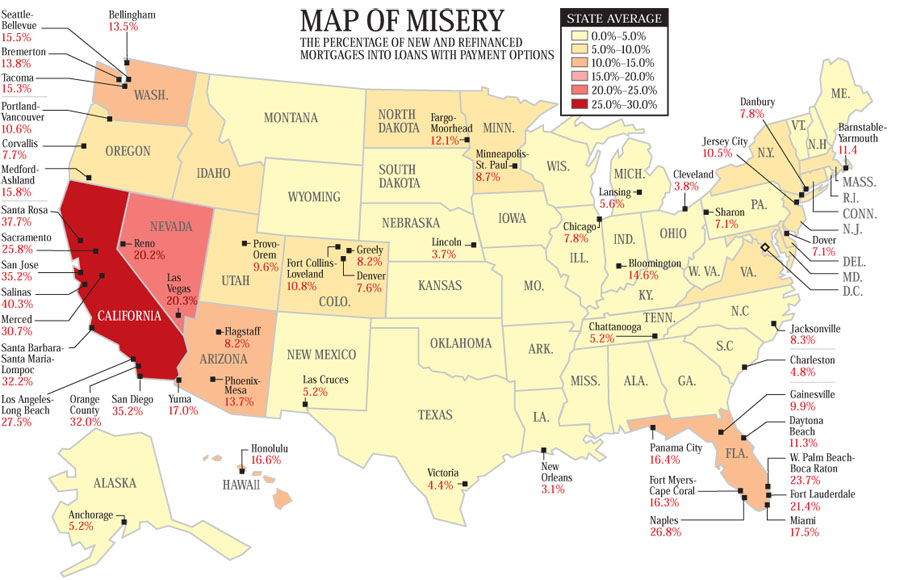
While the map of misery shows a percentage of toxic loans of roughly 15%, I wonder how many of these loans were written in just the last year or so?

Where will future "buyers" get the money for even a 5% down payment. If there are less buyers, what will that do for Seattle home values?

Now that we've seen one homedebtor facing foreclosure story here in Seattle, I wonder how many other stories are out there?

(Lynda V. Mapes, Seattle Times, 05-07-2007)

Monday, April 30, 2007

Vacation Link Roundup

Looks like I didn't miss too much Seattle housing news while I was gone. I'm looking forward to seeing the April numbers next week. Here's a summary of what I noticed while clearing my inbox:

I'm also pleased to report that my nefarious scheme of going on vacation appears to have had the desired effect on the forums. Membership swelled by nearly 30%, and posting activity skyrocketed. Here are a few of the more popular and/or interesting threads:Therefore, I believe it is time to say goodbye to the open threads. For the foreseeable future, all user-driven discussion will take place on the forums. Thanks for your participation. I really enjoy reading what everyone comes up with.

Tuesday, April 17, 2007

World-class not "merely boasting how darn great we are."

If I were the egocentric type, I'd probably think that none other than the P-I's Bill Virgin is a Seattle Bubble reader. A mere five days after I dispelled the notion that Seattle is "world class," Bill delivers the exact same message to a broader audience in today's column: So what makes a world-class city?

Is Seattle a world-class city?
...
During the heady days of No. 1 livability rankings and magazine covers and pop-culture references in music, movies and TV shows, Seattle got to thinking of itself as not just world-class but world-centric.
...
So should anyone care about whether Seattle is world-class?

In fact, there is an aspect to world-class status that goes well beyond meaningless exercises in civic pride (or, some would argue, overly and unjustifiably inflated ego) that does matter, at least in the realm of business and economics.
...
Which brings us to the question of how Seattle stacks up as a world-class city in the business sense.

The answer: Maybe not as well as we used to believe.

Just about every discussion of the economic fortunes of this region focuses on two companies: Boeing and Microsoft — with considerable justification.
...
And after that, what other sectors are there of which we can boast world-class status? Natural resource businesses like timber and fishing no longer figure prominently in the regional economy, much less nationally. Seattle never did emerge as a biotech center the way boosters hoped.

Interestingly, one sector in which Seattle has emerged as a leader is one in which it had not traditionally been a significant player — retailing. Such is Starbucks' status that it has influenced the direction of another giant, McDonald's, while Costco on a national level has forced none other than Wal-Mart to react to it.

Still, the portfolio is a little thin in terms of making Seattle a world-class business center. That's probably just fine with a lot of people. But if Seattle does aspire to world-class status as an economic development strategy, it's got some work to do, beyond merely boasting how darn great we are.

If you have to tell everyone you're world-class, maybe you really aren't.
Ding ding ding! We have a winner. Bill "gets it." Seattle is a nice city, but any way you look at things, it falls short of the "world class" title.

(Bill Virgin, Seattle P-I, 04.16.2007)

Thursday, April 12, 2007

On Luxury Cars and World Class Cities

My car is so great. It has a built-in CD player, a driver's seat with four independent adjustments, a tasteful spoiler, a spacious trunk, climate control, a powered sunroof, and gets over 30 miles to the gallon. It's comfortable, good-looking, and fun to drive. My car is comparable to a BMW or a Lexus, and is a great fit for me. Did I mention how much I like it? I mean, BMW or Lexus are a good fit for some people, but they don't really fit my style. You know though, it really is surprising how cheap it was for me to buy, considering how much other luxury cars go for these days...

So why am I rambling on about my car? What could this possibly have to do with home prices in Seattle?

Every once in a while someone tries to make the case that high home prices in Seattle are justified (or even that prices are too low) on account of what a swell city this is. Their argument goes something like this:

Seattle is so awesome! In fact, Seattle is so swell that it is completely reasonable to compare home prices here to cities such as New York and San Francisco, where homes are much more expensive! Seattle is after all a hip, up-and-coming world class city, probably even the hippest, most up-and-coming world class city around. So you see, it totally makes sense for home prices to shoot through the roof around here. We're just catching up to other comparable cities.
I definitely agree that Seattle is a great place to live. Much like my car, Seattle has many attributes that I really like: low pollution, beautiful scenery, proximity to nature, and a decent job market, to name a few. That being said, comparing Seattle to New York or San Francisco is just as ridiculous as comparing my Saturn SL2 to a BMW or Lexus. They're just not in the same league.

Although I already knew this was the case, since I don't travel much (never been to New York, Boston, San Diego, and have only visited San Francisco once), it didn't really personally hit home with me until my recent business trip to Chicago. Even though I only spent one afternoon cavorting about and seeing the sights, I was immediately struck with the impression of "this is what a real world class city looks like."

These are a few of the things I noticed (and later researched) about Chicago.

Chicago
  • Density: 12,604 people per square mile (source)
  • Extensive Rail system, with 8 different lines running through the heart of downtown (source)
  • Over 2,100 acres of waterfront parks bordering the downtown core (Lincoln Park, Millennium Park, Grant Park, Burnham Park), over 2,800 acres of waterfront parks total
  • 16 major sports teams, with 28 total championship wins (source)
  • Strong blues, soul, jazz, and gospel music scene. Birthplace of House music. (source)
  • World famous government center (Richard J. Daley Center), world famous skyscraper (Sears Tower)
Now here's how Seattle compares in those same categories.

Seattle
  • Density: 6,901 people per square mile (source)
  • Patchwork rail system, with an independent monorail, various street cars, disconnected, infrequent north-south routes, and various in-progress light rail lines. (source)
  • 18.1 acres of waterfront parks bordering the downtown core (Waterfront, Myrtle Edwards, Olympic Sculpture), over 600 acres of waterfront parks total
  • 6 major sports teams, with 4 total championship wins (source)
  • Alternative music scene. Birthplace of grunge. (source)
  • World famous landmark (Space Needle), well-known market (Pike Place Market)
If I had thought of it, I would have asked some Chicago natives whether they think Seattle is an "up-and-coming world class city." I bet they would have laughed at me.

While I was researching this post, I came across the Wikipedia page on world class cities (or "global cities" as they are referred to on Wikipedia). It cites an "inventory of world cities" compiled by a university group in England. In their list, cities can have up to 12 points, with 10-12 point cities being considered "alpha world cities," and so on down the list. Here is the summary of the US Cities categorized on their list:
Alpha world cities (full service world cities)
  • New York (12 points)
  • Chicago (10 points)
  • Los Angeles (10 points)
Beta world cities (major world cities)
  • San Francisco (9 points)
Gamma world cities (minor world cities)
  • Boston (6 points)
  • Dallas (6 points)
  • Houston (6 points)
  • Washington, D.C. (6 points)
  • Atlanta (4 points)
  • Miami (4 points)
  • Minneapolis (4 points)
Seattle shows up way down the list with 2 points, having "some evidence of world city formation." Another categorization is quoted that lists "well rounded global cities" (such as New York, San Francisco, and Chicago) and "worldwide leading cities" (including Miami, Atlanta, and Denver), but Seattle is nowhere to be found on their list.

I mention these lists only to demonstrate that when I say "Seattle is not comparable to San Francisco or New York," it's not because I have some grudge against the city that I call home. I am not alone in my assessment of Seattle as a small city. It's not my biased opinion, it's a fact.

Again, I want to reiterate that I like it here. Seattle is great, and I am happy to call it home. But let's be honest, it is disingenuous to compare Seattle to New York or San Francisco. Let's enjoy Seattle for what it is instead of pretending it is something that it's not.

Much in the same way that I would not pay $40,000 for a Saturn sedan, I am simply not willing to shell out $450,000 for an average house in Seattle.

Update: It seems I've got an ally in Seattle P-I columnist Bill Virgin.

Sunday, April 01, 2007

Seattle Bubble Concedes Defeat

Well everyone, it's been a fun couple of years, but the time has finally come for Seattle Bubble to throw in the towel.

We've analyzed the local market from every conceivable direction, explained all the logical reasons why today's Seattle home prices are not sustainable, watched the national housing market turn from boom to bust, but still the home price increases in Seattle carry on. At this point, there is only one logical explanation why home prices in Seattle have not fallen: Seattle truly is incredibly special.

Of course, I don't just mean "special" as in "isn't it nice to live in a place with such delightful weather, exciting sports teams, and enlightened liberal politics that have solved all of our social problems." Sure, those things are great, but lots of cities can make the same claims (San Francisco, New York, etc.). No, in order to truly understand why real estate prices in Seattle will never go down, one must consider so much more.

Indisputable facts that make Seattle the most specialest place on the planet:
  • Every single house sold has stunning views of Mount Rainer, The Olympics, Puget Sound, and at least three lakes.
  • The Microsoft money factory in Redmond runs non-stop, printing millions of hundred-dollar bills every hour, which are loaded into Boeing planes and dropped from the sky daily, scattering the free money to all homeowners.
  • Every homeowner is issued a brand new pretty pink pony at closing. (Thanks, Chris)
  • Ponies for EVERYONE!
    The waters of all the rivers and lakes contain healing powers that extend life indefinitely, thus allowing homeowners to take on increasingly longer-term loans. This will inevitably lead to the "forever loan," in which principal is never paid down, only interest paid, while the homeowner merely kicks back and enjoys the unending benefits of double-digit appreciation.
  • Ballard.
  • Thanks to Growth Management, not only is it true that "they're not making any more land," but in Seattle, the available land is actually shrinking daily! By 2050, the only buildable land will be within a five-block radius of the Space Needle. 2,000-story ultra-luxury condos will be erected, which will range in cost from $500 trillion dollars for a 50 square foot "sleep pod" to $42 septillion for the 500 square foot "presidential suite."
  • Stunning rainbows fill the sky every afternoon (see above).
Yes, Seattle is truly one in a million. One in a billion. One in a googolplex. With inventory at near-record lows and pending sales increasing over thirty-four percent from January to February, it's plain to see that there's no stopping Seattle's equity spaceship. Of course, all you really need look at is how much prices have appreciated in just the last year (11%, thank you very much) to realize just how special Seattle is.

It is time for this blogger to face the facts: Seattle home ownership is the path to indescribable happiness and untold riches. That's why I'm closing this blog, quitting my job, becoming a full-time Seattle-area home buyer, and recommending that all my readers do the same.

Thursday, March 29, 2007

Spot the Fundamentals, Addendum

Fact: As of 2005, Seattle area per capita income is the 15th highest in the nation (source).

Fantasy: "That pretty much says it all." i.e. - Incomes in the Seattle area are so high, that it doesn't matter how slowly they are growing. High incomes alone will keep home prices from falling.

Reality: Of the six metro areas with higher per capita incomes than Seattle in 2005 that are included in the S&P/Case-Shiller Home Price Index, all six have experienced YOY home price declines in the past year (source). Three of the six have experienced a smaller total increase in home prices since 2000 than Seattle.

The table below shows Seattle and the six other metro areas with larger per capita incomes that are also covered by the S&P/Case-Shiller Home Price Index. "S&P HPI" values are normalized to 100 in January 2000, so the present value (January 2007) indicates how much home prices have risen since then.

RankMetro AreaS&P HPIYOY Chg
2San Francisco, CA211.77-1.4%
4Washington, DC238.05-3.9%
5Boston, MA168.28-5.6%
8New York, NY211.50-0.9%
13Denver, CO135.86-1.1%
14Minneapolis-St. Paul, MN167.98-0.9%
15Seattle, WA183.92+11.0%
Seattle definitely sticks out as an apparent winner, for now. Honestly, I don't know the reason that prices are continuing to rise here, but I do know some things that are not the reason, and "high incomes" is one of those things.

Thursday, March 15, 2007

Seattle 79th Most Affordable Metro

Out of 95 US metro areas, the Seattle-Tacoma-Bellevue housing market ranks as the 79th most affordable. In other words, even with Pierce County dragging the average down, as of 2005 we were still the 17th least affordable metro.

Bizjournals compared housing costs and income levels in the 95 U.S. metros with populations above 500,000. The study used statistics from the 2005 American Community Survey, conducted by the U.S. Census Bureau. From our study, bizjournals identifies the 10 most affordable markets to own a home and the 10 costliest markets to own a home.
Keep in mind that many of the areas that were less affordable than us have seen slight price declines in 2006, meaning we've probably inched up the list a few spots since the data was gathered. Hooray for us!

(G. Scott Thomas, Bizjournals, 03.05.2007)

Monday, March 12, 2007

Seattle Buyers Not Immune to Credit Crunch

As you know, I haven't said much on this blog about the ongoing collapse of lending as we've known it the last few years. This is primarily because the issue is being covered quite thoroughly at many of the other bubble blogs linked on the sidebar. However, a reader sent me a pdf report by Credit Suisse titled "Mortgage Liquidity du Jour: Underestimated No More" that contained the following chart:

As you can see, home buyers in Seattle have turned to interest-only and neg-am loans just about as frequently as most of the other "bubbly" cities.

As this easy money rapidly dries up, where does that leave the buyers? Well, I'll defer to the opinion of a "Mortgage Expert" on that one (comment #2):
It’s a real feeling of panic for buyers.
Uh-oh, it looks like we may not be as special as we thought. It would appear that all of Seattle's pretty scenery and "world class" amenities don't count for diddly when loans are no longer being handed out like bread crumbs at the duck pond.

P.S. (I have the report in pdf format, thanks to the reader that emailed it to me, but since I could not find a web link to it, and I don't know the copyright status of it, I have not posted the report online. If someone finds a link to the full report I will add it to the post.)

Tuesday, February 27, 2007

Seattle is Different. We're Totally Immune.

Dow, Nasdaq, S&P500
Dow, Nasdaq, S&P500 - 02.27.2007
Click to enlarge

Microsoft & Boeing
Microsoft & Boeing - 02.27.2007
Click to enlarge

Update: By request, here is a graph of today's stock performance for a handful of other locally-based companies.
Other Seattle-Area Companies
Seattle-Area Stocks - 02.27.2007
Click to enlarge

For those of you keeping score at home:
  • Boeing: -1.95%
  • Microsoft: -4.12%
  • Amazon: -5.00%
  • Starbucks: -3.94%
  • Nordstrom: -7.59%
  • Costco: -3.48%
  • Washington Mutual: -2.25%
Some immunity.